

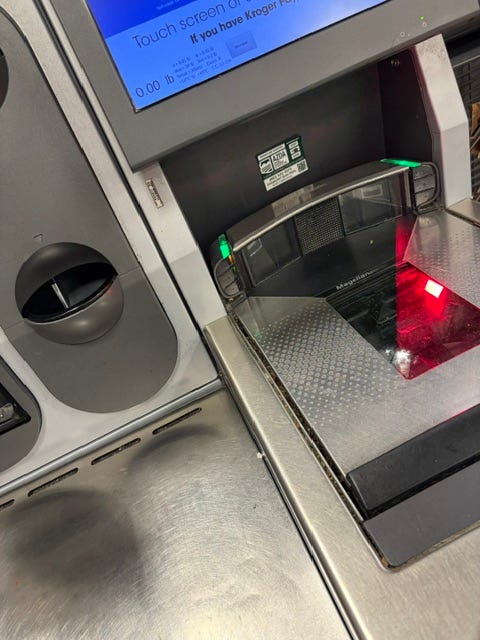
I prefer the self checkout lane at the grocery store. Call it a peeve over how my groceries are bagged, but it’s my default whenever I check out, especially if I don’t have much in my cart. (Or if it’s quiet enough that my extra items won’t invite “stink-eye” from customers or clerks.)
The voice always chimes as you approach, “Welcome, valued customer.” It’s a funny thing to say at this point, because you’re nearly out the door by this time. And your in-store experience has been anything but welcoming up until this point. (Attention Kroger and other corporate grocery lords for the following.)
You’ve likely had to navigate narrow aisles, made more crowded by numerous point of purchase displays in the middle of the aisle as well as those important entry points at the corners. These generally create log jams, and the items in these displays usually bear little similarity to the items in that area, meaning that if you were looking for the items in that errant corner display, you would likely have been in another aisle where the rest of its brethren reside. It’s a scavenger hunt.
For those of us who are under 5’6, you’ve had to stretch beyond your limits, perhaps climb a shelf to reach the item, sitting six to seven feet off the floor, and just resting back far enough to be seen but not reached without the assistance of a cherry picker. Full disclosure, I’ve been yelled at by story personnel for climbing, and have been told to call someone if I need help. And help is rarely ever close by if we’re honest.
Some of the heaviest items, like two liter bottles of soda, are held high on the shelves, requiring challenging physics to extract them from their “chutes,” and if you’re not nimble enough, can tumble forward, nearly beaning you in the head or landing on a toe. Conversely, the milk and dairy that sits in chutes rarely move forward, and the milk you wanted sits mocking you at the far rear of the cart it sits on.
By the time you get to checkout, welcome is the last thing you feel.
Yet, the machine voice is programmed and artificial. At one such visit, the thought occurred to me that I may be no better at “welcome,” and perhaps this was a reminder of how it feels when others feel when I’m oblivious to their struggle or frustration.
Am I patient with someone slower in front of me in the aisle, or do I try to squeeze by because I “need to” get down the aisle?
Do I let the person backing out of their parking space complete the maneuver, or do I buzz past causing them to slam on the brakes?
Do I offer my space in line for someone with fewer items than me?
Do I smile, say hello, say thank you, open the door, or any of a number of small gestures that make someone feel welcome and appreciated?
For me the answer is not enough, in part because I’m too focused on me. Too busy. Too impatient, for what I’m not entirely sure.
Beyond machines, phone prompts, and processes, even real people can get customer service wrong, as Pope Leo can tell you. The Holy Father couldn’t even get a simple change made to his banking information without being hung up on, and then told he may want to move his account elsewhere. Wow.
It can be tough to overcome those signs and messages that make us feel most unwelcome and undesirable, and to combat the insincerity of people who say you are welcome, but do otherwise. (“Your call is important to us. Please hold for an hour.”) The best we can do is offer our best to others, and connect as only humans know how. And rather than rage at the machine, vow to never become one.
A smile goes a long way, it might be the only smile that person has gotten that day.
Great commentary, great piece!